Asset Tag Material and Thickness Selection Guide
Choose asset tag material and thickness from the mounting surface, required rigidity, marking area and current Product mounting options.
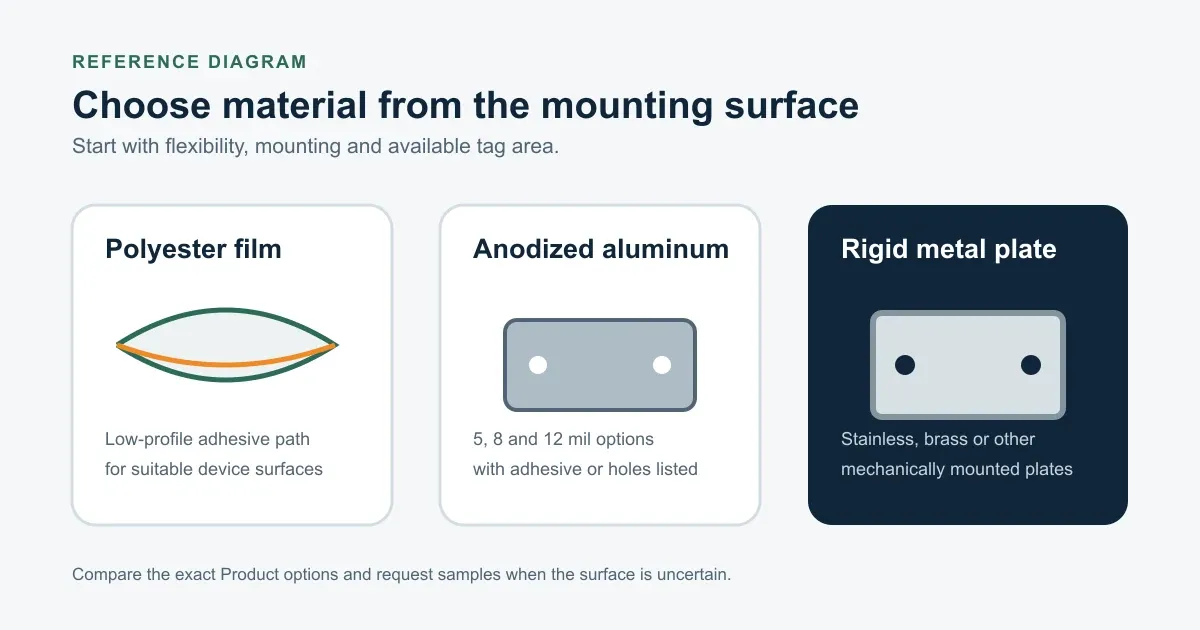
Choose the surface first. Material and thickness follow from that decision.
A smooth laptop housing, a gently curved tool body and a drilled equipment plate do not need the same tag. Compare flexibility, mounting, available marking area and the exact Product options before judging materials by price or a broad durability label.
Compare the main material paths
| Material path | Form | Current mounting path | Start here when |
|---|---|---|---|
| Polyester film | Low-profile flexible film | Adhesive, with removable options on some Products | The asset has a suitable indoor surface and a thin label is preferred |
| Anodized aluminum | Thin metal through more plate-like options | Adhesive or mounting holes on current examples | A metal face is required and the surface can accept the selected thickness |
| 304 stainless steel | Rigid metal plate | Mounting holes on current examples | The specification calls for a rigid mechanically mounted steel plate |
| Brass and other metal tags | Rigid metal plate | Mounting holes on current brass examples | Appearance, legacy equipment or a drawing calls for that material |
These are selection paths, not universal service-life promises. The exact Product, finish, mounting and installation conditions still control the final choice.
Choose aluminum thickness by stiffness and fit
The current anodized aluminum catalog includes 5, 8 and 12 mil Products.
- 5 mil is the least stiff and gives the thinnest listed aluminum path.
- 8 mil is the middle listed thickness.
- 12 mil is the stiffest of the three and behaves more like a plate.
All three same-size examples in the current comparison list adhesive and mounting holes. Their reference prices are different, so compare the quantity tier and final specification rather than assuming thickness alone explains value.
For a direct same-footprint comparison, see 5 mil vs 12 mil anodized aluminum asset tags.
Match the mounting method to the surface
Adhesive needs enough clean contact area for the selected tag. A Product with mounting holes gives a mechanical path when the asset has an existing or approved hole location.
Check whether the tag sits flat, bridges a raised feature or lifts at an edge. For film, inspect curves and corners. For a rigid plate, confirm the hole layout, fastener and rear clearance.
Use the asset tag installation guide after the material is narrowed.
Confirm that the data fits the face
Logo, visible text, barcode, QR code and serial data all compete for marking area. A small Product may support the code type but still need a larger face for the buyer’s exact payload and readable fallback text.
Choose the code workflow, send the actual data and review the proof before reducing the tag size.
Use samples to settle uncertain surfaces
Request samples when the surface is curved, textured, coated, repeatedly cleaned or sensitive to adhesive removal. Test the planned location with the real handling and scanner workflow.
Displayed Product prices are references. Finish, mounting, data and other custom options can change the unit price by about US$0.30 to US$0.60 per piece. The written quote confirms the material, specification and final price.
Current 0.75 x 1.5 inch aluminum options
The specifications and reference prices in these tables are read from the current Product catalog.
| Criteria | 5 mil | 8 mil | 12 mil |
|---|---|---|---|
| Product | Warehouse Aluminum Asset Tag — 0.75 x 1.5 in (19x38 mm) Rectangle, 5 mil anodized aluminum (0.1 mm) | Fixed-Asset Aluminum Heavy-Duty Asset Tag — 0.75 x 1.5 in (19x38 mm) Rectangle, 8 mil anodized aluminum (0.2 mm) | Aluminum Asset Tag — 0.75 x 1.5 in (19x38 mm) Rectangle, 12 mil anodized aluminum (0.3 mm) |
| Size | 0.75 x 1.5 in (19×38 mm) | 0.75 x 1.5 in (19×38 mm) | 0.75 x 1.5 in (19×38 mm) |
| Thickness | 5 mil anodized aluminum | 8 mil anodized aluminum | 12 mil anodized aluminum |
| Selection cue | Thinner aluminum; follows a gentle curve more easily | Middle thickness between thin aluminum and a plate | Stiffest of the three; stays visibly flat |
| Mounting | Adhesive, Mounting holes | Adhesive, Mounting holes | Adhesive, Mounting holes |
| Product production range | 5-8 business days after proof approval | 5-8 business days after proof approval | 5-8 business days after proof approval |
Reference Product tiers in USD
| Quantity | 5 mil | 8 mil | 12 mil |
|---|---|---|---|
| 100 pieces | $97.96 total $0.98/pc | $174.53 total $1.75/pc | $217.00 total $2.17/pc |
| 300 pieces | $185.00 total $0.62/pc | $404.60 total $1.35/pc | $450.00 total $1.50/pc |
| 500 pieces | $270.00 total $0.54/pc | $569.50 total $1.14/pc | $620.00 total $1.24/pc |
| 1000 pieces | $430.00 total $0.43/pc | $797.30 total $0.80/pc | $868.00 total $0.87/pc |
The displayed tier is a reference price for the product specification shown on the page. Standard artwork setup and the digital proof are included.Custom options typically change the unit price by about US$0.30-US$0.60 per piece.Your written quote confirms the final specification and price before production.The displayed total is delivered duty paid: freight, import duty and customs clearance are already inside it, and nothing further is collected on arrival. Rush production and custom sample fees are the only items quoted outside it.
Request samples to check surface fit and mounting before the production run.
Frequently asked questions
- Which asset tag material should I start with?
- Start with the mounting surface and required rigidity. Polyester is a low-profile adhesive path for suitable indoor surfaces. Anodized aluminum offers 5, 8 and 12 mil options in the current catalog. Rigid metal plates suit approved mechanical mounting.
- What is the difference between 5, 8 and 12 mil aluminum?
- Five mil is the least stiff of the three listed options, 8 mil is the middle thickness and 12 mil is the most plate-like. Confirm fit and mounting on the actual surface.
- Can metal asset tags use adhesive?
- It depends on the Product. Current anodized aluminum examples list adhesive and mounting holes. Current rigid stainless-steel and brass examples are generally listed with mounting holes.
- When should I request samples?
- Request samples when adhesion, curvature, texture, cleaning, removal or code scanning is uncertain. Test the actual surface and planned location.